
Oxford Centre for Applied Superconductivity
What is superconductivity?
Image
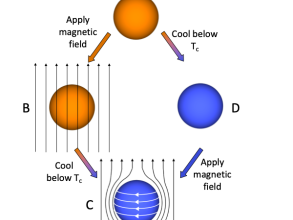
Diagram showing Meissner effect in a superconductor
When some materials get cold enough, they lose all of their electrical resistance and become 'superconducting'. Unlike a normal wire which heats up when electricity is passed through it due to electrons bumping into the atoms, a superconducting wire has zero resistance so it will transport electricity without losing any of the energy as heat. This is extremely useful and has applications in power, transport, efficient engines, super-strong magnets like those used in MRI scanners, levitating trains, fusion magnets and a whole host of other things too.
A byproduct of this phenomenon is that magnetic fields are pushed out of the superconductor, since the electrons can move in currents that cancel the magnetic field exactly, without ever slowing down. This phenomenon is known as the Meissner effect. In practical superconductors, it is possible to trap magnetic field inside the material in the form of quantised flux lines. This enables superconductors to exhibit ultra-stable magnetic levitation.
Superconductivity can nevertheless be destroyed in three ways: too much current, a magnetic field that is too high, or an increase in temperature above the so-called 'critical temperature' - any of these is enough to break the delicate state the material must be in to be superconducting.
Based on text written by Sam Sutherland as part of a summer project in the CfAS Physics lab